
Binge Eating Recovery: Top 3 Tips

When it comes to binge eating disorder recovery, every journey is unique. There is certainly not a one size fits all approach, however there are certain strategies that can be very helpful for most everyone at the start of their recovery. Today I would like to share with you my top 3 tips for beginning your binge eating disorder recovery. My hope is that you will find a strategy within this article to help ground you with a place to work within and begin. Know that as you explore these tips, no ones recovery is linear, and there is certainly not a version of this where we move thorugh it perfectly. There will be ups and downs, certainly still binges, and in time there will be more ups than downs, more awarness, more mindfulness. This is what recovery looks like.
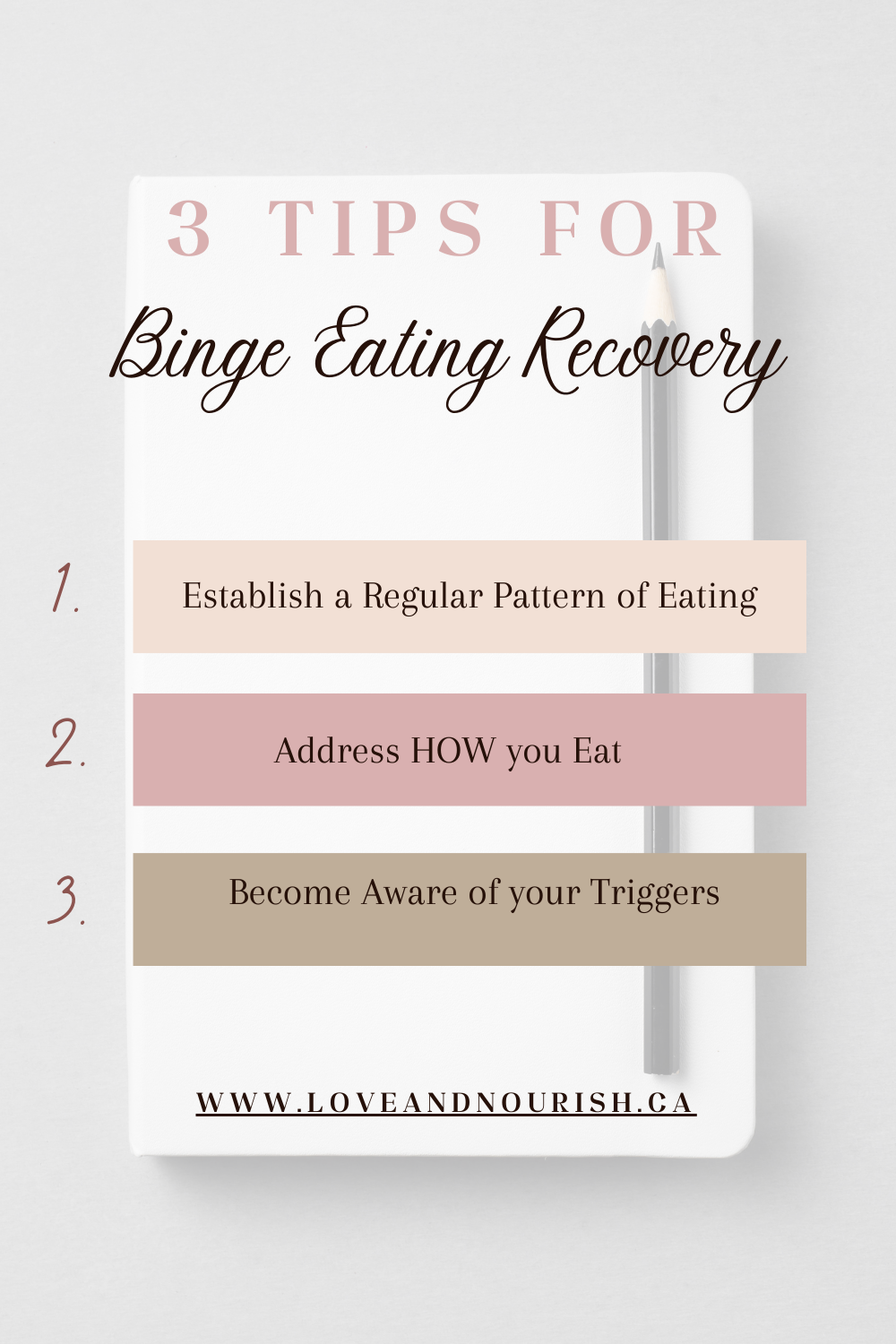
Top 3 Tips for Binge Eating Recovery:
Establish a Regular Pattern of Eating:
In time, you will be able to honour your hunger and fullness, listen to your body, and choose what she is asking for. This is known as eating intuitively. What I have found is that when you have been struggling with an eating disorder, your head and body are quite disconnected! Reconnecting, and trusting your body, can take time. When you are at day one, week one, or even month one, it is imoprtant to ensure that your plate is balanced, that you are providing your body with all the nutrients she needs, that you are therefore helping to keep your blood sugar balanced (which helps prevent binges!) and eating with enough regularity to ensure that you do not get triggered to binge due to becoming too hungry.
So how do you begin to establish a regular pattern of eating?
Step 1: The first thing I would suggest is to begin to work towards making sure your plate is balanced and find a few simple meals that you can go to without overthinking it. I created a freebie with an easy build a meal formula + recipes + nutrition information on how to balance your plate. This is a wonderful place to begin and you can download it here.
Step 2: Once you have some easy meals picked out that include all your macronutrients (carbs, fats and proteins), the next thing I would suggest you do is look at your day (your work schedule, when you wake up, when you get home, etc.) and using your typical day, map out your approximate meal times. So this means when you have breakfast, lunch, dinner and snacks. If there is a challenging time of day for binges, such as after dinnner for example, I would make sure to plan a snack for this time to help use your meals and snacks as stepping stones through the day.
[TOP TIP! Even if you binge, try and get back on your next planned meal or snack! I know this feels counterintuitive, but it can be really helpul- promise!]
Address HOW you Eat:
Within an eating disorder, we become quite fixated on what we do and don’t eat, how much, and when. Often, when we approach recovery, we maintain that fixation. But I want to tell you that from what I have seen after working with hundreds of clients, is that how we eat is often even more important than what we eat when it comes to binge eating disorder recovery.
(Learn more about how vs what we eat in eating disorder recovery here!)
What do I mean by ‘how’ you eat?
When I say to focus on how you eat, I mean the following:
-Where do you eat? Are you eating on your couch, in bed, at your kitchen table, at your desk , standing in front of the fridge or pantry?
-Do you eat mindfully or with distractions? Such as TV, social media, work, etc.
-Do you eat fast or slow? Do you rush through your meal, multitask while you eat, eat very quickly while feeling guilty over your choices?
I would really encourage you to explore these before obsessing over your food choices further. Shifts here can make a huge difference to your recovery and relationship with food and body.
Become Aware of your Triggers:
Everyone has certain things that trigger the eating disorder. Some people I work with are highly aware of these, while others don’t even realize how much a certain person, place or situation triggers them until we begin unpacking the food behaviours. Afterall, we don’t have an eating disorder for no reason. It is in fact serving some purpose for you, whether that is an outlet for an uncomfortable feeling, a response to a triggering person, a way to pass an uncomfortable stretch of time, or permission to let go.
(Read more about how to navigate triggers to binge eat here).
What do I mean by ‘trigger’?
A trigger can be anything that causes a response within you to binge eat, usually due to hightened emotions or discomfort. Some of the most common examples I see in clinic are the following:
-Unstructured time
-Strong association between unrestricted eating and watching TV (often these are foods the individual will not allow themselves to eat outside of the act of watching TV and “letting go”)
-A family member or partner or other relationship that brings up uncomfortable feelings (interactions with these individuals like a family dinner, a daily phone call etc. can trigger a binge once that interaction is over)
-Going on a diet or following a restrictive meal plan (once we begin a new diet or a new way to control our bodies, it is only a matter of time before we go into “f*ck it mode” and eat everything we have taken away from ourselves! Restriction always leads to a binge)
Of course there are many more triggers than these, and it can be anything. I would suggest that you begin to bring more awareness to your day. When you binge, or feel the urge to binge, I encourage you to get curious with yourself.
-What were you doing right before?
-Did you just get off the phone with someone?
-Were you anticipating something that made you nervous?
-Are you bored?
Once you have awareness around what is triggering you to binge you can begin to get ahead of it and put things in place in your day and around these triggers to help keep you more safe from the eating disorder. In work together, we look at strategies called symptom interuptions that really help with this.
I included a lot of infortmation here today. Take a deep breath and please don’t try and do everything all at once! The slower you go, the faster you get there. Choose one of these tips that resonated with you, or simply begin with step 1. Allow yourself space to move through that step and get comfortable with it before moving to the next. This is an act of kindness to self and is so important! And, as always, of you would like more support through the process, reach out. I am happy to work with you and support you each step of the way.