How to Know if you’re Actually Hungry

When we are actively in any disordered eating patterns or forms of dieting, our heads and bodies become quite disconnected. Our heads are making all the decisions about what to eat and when, irregardless of what our body actually wants or needs. This is not only exhausting, but it is also not sustainable. At the end of the day, we simply cannot outrun our bodies needs, and the more we try and suppress this, the more likely we are to end up in a binge and restrict cycle.
So how do you reconnect to your body and learn when you are ACTUALLY hungry or full?
The best place to start reconnecting with your body and its hunger cues, is a tool called the hunger scale.
What is a hunger scale?
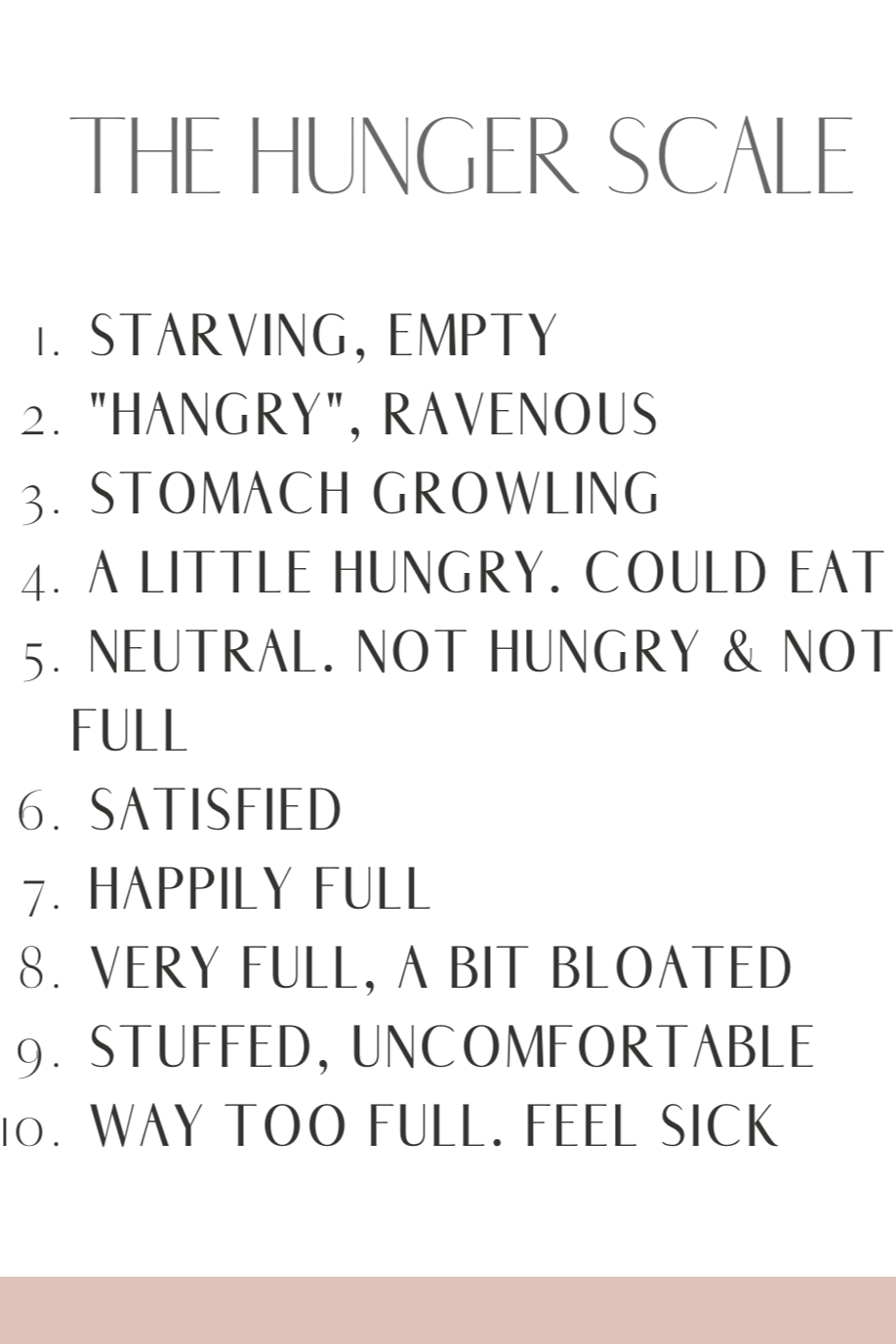
This is a scale numbered from 1-10 (pictured above). 1 and 10 are the extremes: starving and stuffed. Mostly all of us know what it feels like to be too hungry and too full, but very few us of are tuned in to the more subtle signs of hunger or fullness (numbers 4-7 on the hunger scale) that can gently nudge us to get food before our blood sugar drops (before we get “hangry”!), and to stop eating before we get uncomfortably full.
Why is learning our hunger and fullness cues important?
Each day, for a variety of reasons, our hunger and fullness shift. Maybe you are getting sick and feel less hungry, or have had a more active day and are more hungry, or are in your luteal phase (the 2 weeks before your period) and have an increased need for calories and carbohydrates. Whatever the reason, the point is that your body is not stagnant. When you are able to tune into the physiological (vs mental + emotional) hunger cues, you are able to get out of your own way and let your body guide you. This simplifies things immensely, as your body always knows best. And the best part about this is that you really can trust your body! It is wonderfully freeing to not measure foods, stick to rigid meal plans, or count calories. And no longer needing these outside resources will help you leaps and bounds in your recovery from binge eating.
How do I begin to use the huger scale?
The best way to begin, is to check in with the hunger scale, before and after each meal. You don’t need to make any changes to if/ what you are eating just yet. Just familiarize yourself with your hunger and fullness cues, beginning to pay attention to what it feels like in your body and where you feel the different sensations of the various levels of hunger and fullness.
Once you are more familiar with these cues, you can begin to play around with checking in with your body before deciding to eat, to see if you are truly hungry. You can also begin tuning into your body during a meal, to see if you are still hungry!
This can go a number of ways. You may realize you need to eat more after one plate of food, noticing that you are not satisfied or full just yet. Honour this. It is important and will help to prevent binges later on. You may also notice that you are not truly hungry at a time when you had planned to eat. Explore what it feels like to wait until your body is ready. Remind yourself that you are safe to do so, knowing that you are always allowed food and are able to enjoy what you want, when you want it (even if past experiences have shown you otherwise).

The hunger scale is a great tool to begin to reconnect with your body and her needs. But yes, it takes work, in that to experience this re-connection, you must use this tool often until it begins to feel like second nature again (things work best when you put in the work… you know?) And the more we learn and choose to connect with self again, the more space we create between our recovery and the eating disorder. No this is not easy, nor is it comfortable, but it is 100% worth it.
And if you want to chat about recovering from binge eating, then reach out! I offer free calls where you can share with me what is going on for you and I can share how I can best support. You’ve got this!